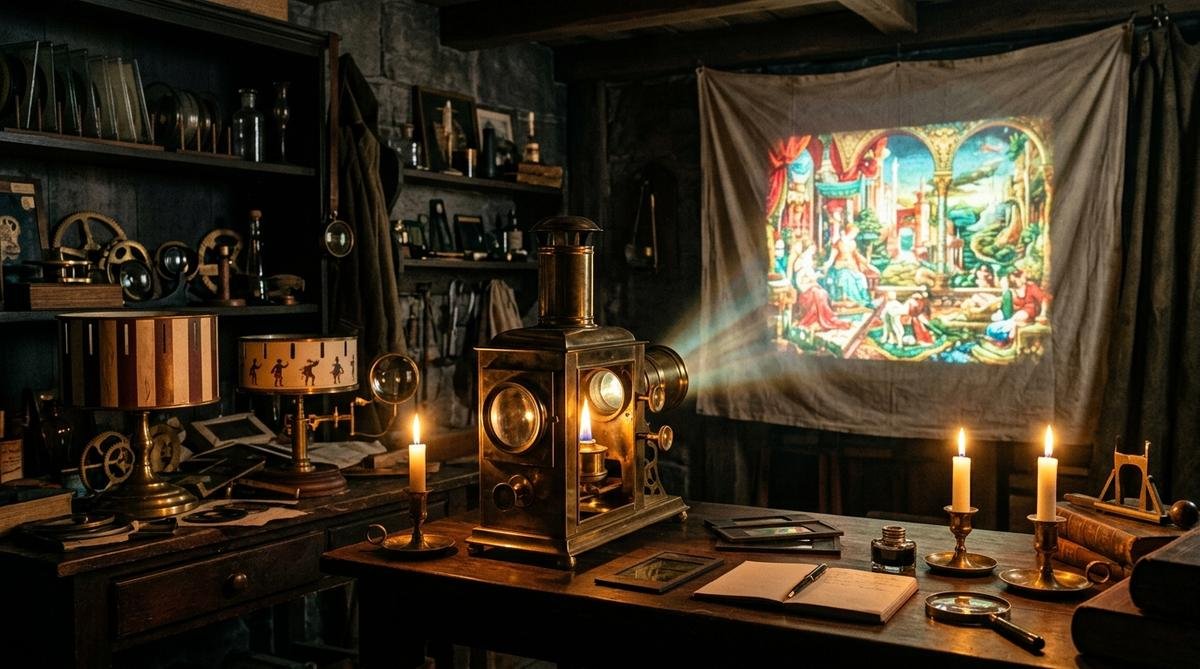
The Ancestral Hunger for Motion: The Dawn of Animated Illusion
Long before the advent of celluloid film, projection booths, or luminous digital screens, human civilization possessed an innate psychological yearning to capture and simulate physical movement. In subterranean prehistoric caverns such as Chauvet and Altamira, Paleolithic hunters rendered bison, horses, and ibexes with multiple overlapping limbs across undulating limestone walls. When the flickering, amber glow of animal-fat torches danced across these ancient contours, the animal figures appeared to gallop through the darkness. This primeval impulse to synthesize temporality through static illustration represents the true conceptual genesis of animation—a relentless quest to transcend the frozen permanence of the graphic arts and breathe artificial vitality into inanimate form.
For millennia, however, the synthesis of motion remained constrained by the lack of mechanical apparatuses capable of exploiting the intricate neurobiology of human sight. The transition from sacred cave wall to scientific novelty occurred gradually across centuries, catalyzed by Renaissance optics, seventeenth-century projection mechanics, and nineteenth-century physiological research into how the eye and brain process luminous stimuli. Understanding the historical emergence of animation necessitates an examination of the optical toys, philosophical apparatuses, and illuminated lanterns that collectively bridged the vast chasm between passive pictorial contemplation and active kinetic illusion.
The philosophical foundation of animated imagery rests upon the complex interplay between retinal stimulation and cerebral synthesis. While nineteenth-century experimenters initially attributed the illusion of motion to a crude mechanical persistence of vision—the theoretical notion that the retina retains a photochemical impression for a fraction of a second after an image disappears—twentieth-century neuroscientists demonstrated that true animated perception arises from higher-order cognitive mechanisms, namely the phi phenomenon and beta movement. These psychological mechanisms bridge discrete spatial intervals, compelling the human visual cortex to interpret rapid, sequential static images as a continuous, unified trajectory of organic movement.
🔬 Scientific Milestone: Peter Mark Roget and the 1824 Royal Society Paper
In December 1824, English physician and mathematician Peter Mark Roget presented his landmark paper titled ‘Explanation of an Optical Deception in the Appearance of the Spokes of a Wheel Seen Through Vertical Apertures’ to the Royal Society of London. Roget’s mathematical analysis of how moving wheel spokes appear stationary or curved when viewed through slotted palings provided the rigorous theoretical impetus that led Continental physicists to invent stroboscopic motion apparatuses.
The Magic Lantern and Phantasmagoria: Projecting Shadows and Phantoms
The earliest true ancestor of animated cinematic projection was the magic lantern (Laterna Magica), conceptualized in the mid-seventeenth century by polymaths such as the Dutch physicist Christiaan Huygens and the German Jesuit scholar Athanasius Kircher. Comprising a concave spherical mirror, a combustible light source—originally tallow candles or oil lamps, and later incandescent lime light—a condenser lens, and an objective tube, the magic lantern projected enlarged hand-painted glass transparencies onto whitewashed walls or stretched linen sheets. Early lanternists quickly recognized that static illumination lacked theatrical tension; audiences demanded dramatic transformation and visual metamorphosis.
To overcome the stillness of the glass slide, inventive artisans engineered intricate mechanical lantern slides featuring miniature brass levers, geared wheels, and sliding glass plates. The ‘slip slide’ utilized two overlapping glass panes, allowing a showman to pull a lateral wooden slider to instantly alter an image—transforming a sleeping monk’s closed mouth into a yawning cavity swallowing rats, or replacing an empty sea with a monstrous aquatic leviathan. Even more sophisticated were ‘lever slides’ and ‘chromatropes’, where counter-rotating discs painted with kaleidoscopic geometric ribbons generated hypnotic, pulsating optical vortexes when cranked by hand.
In late eighteenth-century Paris, Belgian stage illusionist Étienne-Gaspard Robert, performing under the theatrical pseudonym Robertson, pushed magic lantern mechanics to its terrifying apotheosis with his legendary ‘Phantasmagoria’. Staged within the ruined, subterranean crypts of an abandoned Capuchin convent, Robertson concealed the magic lantern on a wheeled carriage behind a translucent gauze screen soaked in wax. By wheeling the lantern backward while adjusting its focal ring, Robertson caused projected apparitions of specters, bleeding nuns, and historical ghosts to expand smoothly and hurtle toward screaming patrons. Robertson’s phantascope was the first projection device to employ dynamic camera movement, simulated tracking shots, and cinematic zooms decades before motion picture cameras existed.
Key Optical Innovations of the Mechanical Lantern Slide Era
The technical ingenuity embedded within Victorian mechanical slides foreshadowed modern frame composition and sequential editing. Craftsmen developed specialized nomenclature and construction techniques that established the vocabulary of cinematic transition:
- The Dissolving View Slide: Pioneered by Henry Langdon Childe in the 1830s, this technique utilized two adjacent lantern objectives equipped with mechanical brass diaphragms. By simultaneously closing one shutter while opening the other, a summer alpine meadow melted imperceptibly into a snow-covered winter landscape, inventing the cinematographic cross-dissolve.
- The Pulley and Belt Slide: Miniature leather or string pulleys connected to external brass handles enabled lanternists to animate continuous orbital mechanics, such as comets streaking across celestial starfields or planetary bodies revolving around the sun in astronomical lectures.
- The Eccentric Cam Action Slide: Intricate internal cam mechanisms converted rotary hand motion into complex asymmetric reciprocating actions, such as the lifelike flapping of a bird’s wings or the violent pitching of a sailing vessel trapped in a maritime storm.
- The Panoramic Panoramic Scroll Slide: Long, continuous glass strips were drawn through specialized wooden stages, creating scrolling panoramic backdrops that prefigured lateral tracking shots and background scrolling in classic side-scrolling animation.
| Apparatus / Device | Key Inventor | Year | Primary Optical Principle | Cinematic Legacy |
|---|---|---|---|---|
| Magic Lantern | Christiaan Huygens | 1659 | Lens projection of illuminated glass transparencies | First shared optical projection system |
| Phantascope | Étienne-Gaspard Robertson | 1798 | Rear-projection on wheeled tracks with focal pulling | Pioneered camera movement, tracking zooms, and immersion |
| Thaumatrope | John Ayrton Paris | 1824 | Superimposition via rapid mechanical axial rotation | Retinal image fusion demonstration |
| Phenakistiscope | Joseph Plateau | 1832 | Radial slotted disc spinning before a planar mirror | First true cyclical frame-by-frame animation system |
| Zoetrope | William George Horner | 1834 | Cylindrical drum with vertical stroboscopic viewing slits | Group viewing of continuous animated loops without mirrors |
| Praxinoscope | Émile Reynaud | 1877 | Central polygonal prism of mirrors replacing slit occlusion | Eliminated distortion and increased screen brightness |
The Golden Era of Victorian Optical Toys: From Thaumatrope to Zoetrope
The nineteenth century witnessed a sensational proliferation of parlor novelties and scientific optical toys that transformed esoteric optical laboratory findings into popular commercial entertainment. In 1824, English physician John Ayrton Paris popularized the ‘Thaumatrope’ (literally ‘wonder-turner’). Consisting of a modest cardboard disc suspended between two silk cords, the toy featured complementary illustrations on opposite faces—most famously, a songbird on the obverse and an empty gilded cage on the reverse. When twirled vigorously between thumb and forefinger, the rapid rotational inversion fused the two separate graphics into a single compound perception: the bird appeared securely imprisoned within the cage.
While the thaumatrope demonstrated simple retinal superposition, it could not simulate progressive directional displacement. That breakthrough occurred in 1832 through the independent investigations of Belgian physicist Joseph Plateau and Austrian geometry professor Simon Stampfer. Plateau designed the ‘Phenakistiscope’ (spindle viewer), consisting of a flat cardboard disc mounted on a central handle. Around the disc’s perimeter was an array of radial vertical slits, beneath which was drawn a sequence of figures depicting progressive increments of an action—such as an acrobat executing a somersault or a devil swallowing a skull.
To view the animation, the user stood directly before a mirror, held the printed side toward the reflection, spun the disc, and peeked through the passing slits. The cardboard sector between each slit acted as a mechanical shutter or stroboscopic chopper, briefly occluding vision and preventing retinal motion blur. As each slit flashed past the observer’s pupil, the mirror reflected an isolated, freeze-frame image. The visual cortex effortlessly linked these intermittent static exposures into an exhilarating, seamless cyclic performance. Plateau had invented the first true frame-by-frame animated medium.
⚙️ Engineering Insight: The Stroboscopic Chopper and Critical Flicker Fusion
The critical technical limitation of early slotted toys was luminous attenuation. Because the opaque cardboard disc blocked light for approximately 90% of each rotation cycle, the animated image appeared noticeably dim. To achieve smooth apparent motion, the device required a minimum presentation frequency of 16 to 24 interruptions per second—surpassing the human eye’s critical flicker fusion threshold, where discrete light pulses blur into continuous perceptual luminescence.
Horner’s Zoetrope and Reynaud’s Praxinoscope: Democratizing the Loop
Although Plateau’s phenakistiscope produced remarkably fluid illusion, it suffered from severe practical liabilities: it required a mirror to operate, and only a solitary individual could experience the spectacle at any given instant. In 1834, British mathematician William George Horner circumvented these structural defects by designing the ‘Daedalum’ (wheel of the devil), subsequently patented in the United States and Britain as the ‘Zoetrope’ (wheel of life) by Milton Bradley and William F. Lincoln in 1867.
Horner re-engineered Plateau’s flat disc into an open-topped cylindrical metal drum mounted upon a free-spinning vertical pedestal. The upper rim of the drum was pierced with evenly spaced vertical viewing apertures, while the lower internal perimeter held interchangeable paper strips printed with twelve to sixteen progressive lithographic drawings. Multiple spectators gathered around the circular drum could simultaneously peer through the passing outer slits to behold the inner figures dancing, boxing, or jumping ropes. The zoetrope eliminated the mirror, democratized domestic animated entertainment, and introduced the modular, standardized strip-format that would subsequently dictate commercial film packaging.
Despite its sensational popularity, the zoetrope retained the optical handicap of stroboscopic slit occlusion: the image remained inherently dim, and rapid lateral spinning introduced subtle geometric distortion and motion blur. In 1877, French science teacher, artist, and mechanical genius Charles-Émile Reynaud achieved a breathtaking optical triumph by inventing the ‘Praxinoscope’. Reynaud brilliantly discarded the slotted outer cylinder entirely. In its place, he erected a concentric central prism consisting of twelve to sixteen planar glass mirrors angled around the central pivot point.
As the outer drum containing the printed illustrative strip revolved, each mirror reflected the opposite drawing directly toward the viewer’s eye. As the drum rotated, the reflecting surface moved smoothly in precise optical synchrony with the passing image, causing the virtual reflection to remain stationary in space before instantly dissolving into the subsequent mirror facet. The praxinoscope generated an animated loop of unprecedented luminosity, crystalline clarity, and chromatic brilliance, unmarred by the dark interruptions or blurred vignetting of earlier slotted toys. Reynaud had laid the direct technical foundations for theatrical animated projection.
Chronophotography and the Mechanical Synthesis of Life
While optical toys animated hand-drawn caricatures, the scientific world demanded the analytical decomposition of real biological movement. In the late 1870s and 1880s, British photographer Eadweard Muybridge and French physiologist Étienne-Jules Marey pioneered ‘chronophotography’. Muybridge famously set up a linear battery of twenty-four stereoscopic cameras triggered by tripwires along a racecourse in Palo Alto, California, proving definitively that all four hooves of a galloping horse leave the ground simultaneously beneath the animal’s abdomen.
To synthesize these photographic findings back into kinetic reality, Muybridge invented the ‘Zoopraxiscope’ in 1879—a hybrid device combining the magic lantern with Plateau’s phenakistiscope disc. Muybridge transferred his photographic silhouette sequences onto circular glass discs, rotating them between a projection lamp and a counter-rotating slotted shutter. When projected before spellbound European and American scientific academies, Muybridge’s silhouettes of running greyhounds, soaring birds, and sprinting athletes represented the first cinematic projection of live-action locomotion synthesized from sequential photography.
Meanwhile, Marey developed the photographic rifle and fixed-plate chronophotography, recording multiple overlapping phases of motion on a single photographic emulsion. Marey’s scientific inquiries into biomechanics, bird flight, and muscular locomotion provided the anatomical and mechanical reference plates that early twentieth-century cartoonists and animators—including Winsor McCay and Walt Disney—would study diligently to understand the acceleration, deceleration, and weight transfer essential to lifelike character animation.
The Enduring Legacy: How Optical Toys Defined Modern Animation Grammar
The transition from Victorian parlor novelties to modern industrial animation did not discard the principles forged in the nineteenth century; rather, it codified and automated them. Every foundational principle of contemporary motion design, 2D vector animation, stop-motion cinematography, and high-end 3D CGI can trace its lineage directly to the mechanical constraints of these early optical devices:
- The Fundamental Animation Loop: The zoetrope and phenakistiscope mandated cyclical repetition due to physical drum circumferences. This constraint birthed the modern ‘walk cycle’, ‘run cycle’, and environmental looping techniques that remain ubiquitous in modern game design and digital character staging.
- Variable Frame Rates and Shutter Timing: The physical spacing and width of zoetrope slits established the principles of mechanical shutter angles and exposure durations, establishing the scientific baseline that 24 frames per second (or 12 frames shot ‘on twos’) produces the ideal compromise between economic labor and psychological fluidity.
- The Marriage of Engineering and Artistry: The creators of early animation were not merely illustrators; they were physicists, horologists, mechanicians, and optics specialists. This rigorous dual discipline established the precedent that animation is fundamentally a technological art form, requiring seamless synergy between creative draftsmanship and precision tooling.
In retrospect, the magic lantern, phenakistiscope, zoetrope, and praxinoscope were far more than quaint historical curiosities. They represented the critical experimental crucible in which humanity mastered the mechanics of illusion. By deconstructing the physical universe into micro-intervals of time and reconstituting them through the lens of human perception, these Victorian pioneers transformed illustration into cinema, laying the magnificent groundwork for an artistic medium that would capture the imagination of the entire planet.