The Convergence of Photography and Drawing: The Rotoscope Genesis
Throughout the tumultuous history of the animated film, a persistent, fierce philosophical debate has raged over the boundary separating pure artistic draftsmanship from photographic tracing. For purists who view animation as an act of pure, unmediated graphic imagination springing entirely from an artist’s mind, the reliance on live-action photographic reference has often been viewed with suspicion, dismissed as a mechanical shortcut or an artistic crutch. Yet for the visionary inventors, directors, and technological pioneers who shaped the medium, photographic tracing—known historically as ‘Rotoscoping’ and in its modern digital incarnation as ‘Performance Capture’—was never a cheap shortcut. It was a revolutionary scientific bridge that allowed cinema to capture the unvarnished, authentic anatomical weight and psychological nuance of living human performance.
The origins of this transformative methodology trace back to a modest family apartment in Brooklyn, New York, during the dark days of the First World War. In 1915, Austrian-American inventor and cartoonist Max Fleischer was driven to distraction by the jerky, weightless, unnatural locomotion of early silent cartoons. Characters moved like stiff mechanical cardboard dolls or rubbery blobs, completely failing to replicate the fluid acceleration, skeletal gravity, and graceful inertia of real human walking cycles. Fleischer realized that the only way to conquer this anatomical defect was to marry the photographic camera directly to the animator’s drafting table.
Between 1915 and 1917, Max Fleischer engineered and patented the ‘Rotoscope’—a device that projected live-action film footage frame by frame onto a glass drafting surface, allowing an animator to trace human movements with absolute physical fidelity. This singular invention did not merely transform the Fleischer brothers into Hollywood titans; it inaugurated a century-long technological lineage that spans from Koko the Clown and Betty Boop to Ralph Bakshi’s gritty fantasy epics, Richard Linklater’s interpolated digital dreamscapes, and James Cameron’s revolutionary performance-capture breakthroughs in ‘Avatar’.
📜 Patent Landmark: Max Fleischer’s U.S. Patent No. 1,242,674 (1917)
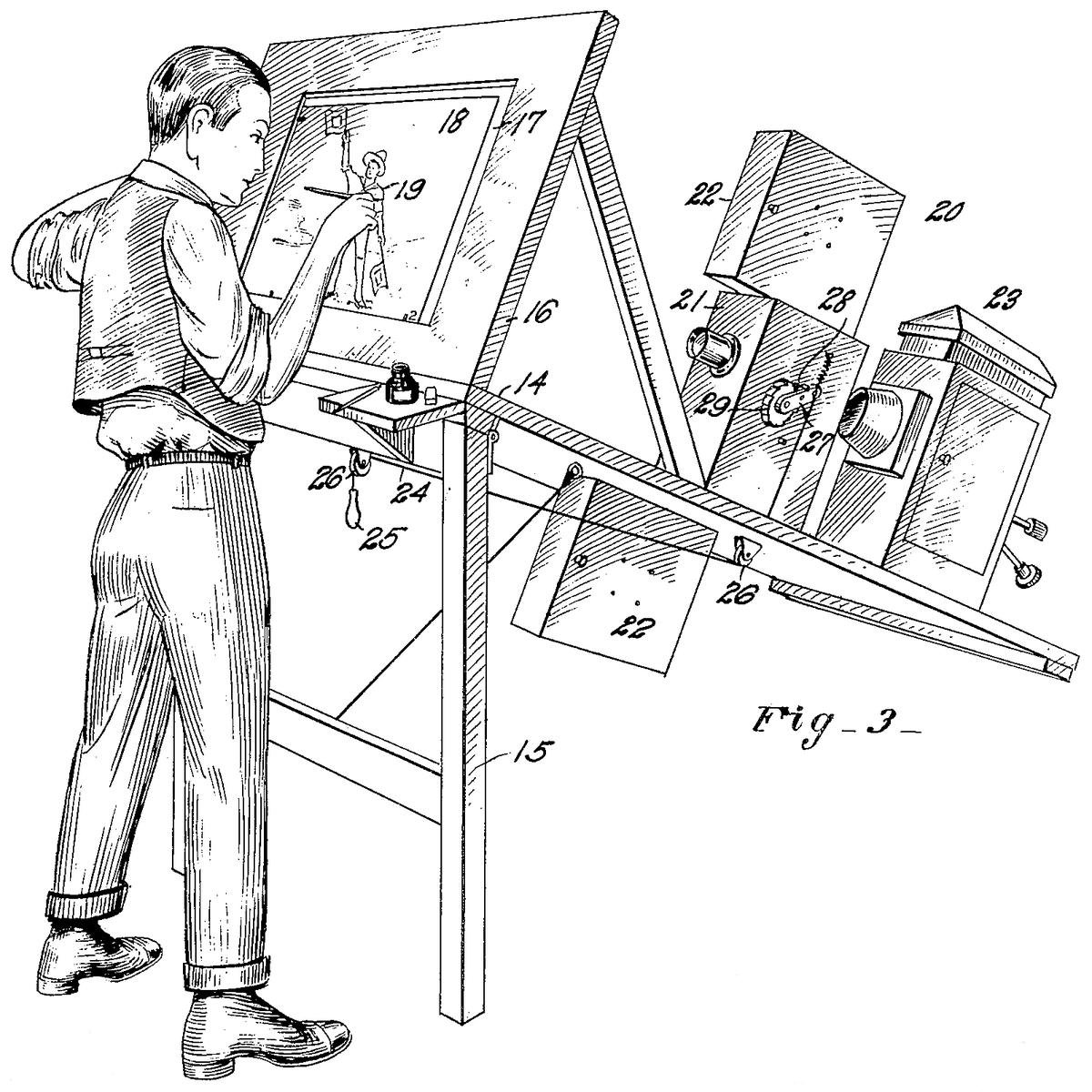
On October 9, 1917, Max Fleischer was officially granted U.S. Patent No. 1,242,674 for the ‘Method of Producing Moving-Picture Cartoons’. Fleischer’s patent drawing depicted a modified camera projector bouncing individual frames of live-action 35mm film through an angled mirror onto a translucent glass drafting platen, establishing the foundational mechanical architecture of all rotoscopic systems for the next century.
The Mechanical Architecture of the Original Fleischer Rotoscope
To appreciate Max Fleischer’s mechanical genius, one must deconstruct the electromechanical design of the original 1915 Rotoscope apparatus. The system was a marvel of optical engineering constructed from repurposed bicycle parts, photographic lenses, and custom brass gears in the living room of Fleischer’s home:
- The Live-Action Photographic Stage: Max dressed his younger brother, Dave Fleischer, in a tailored clown costume with bold white ruffs and black pom-poms. Dave was filmed on the rooftop of their apartment building under bright midday sunlight, executing exaggerated athletic routines, somersaults, handstands, and comedic tap dances using a hand-cranked 35mm camera.
- The Frame-by-Frame Optical Projector: The developed 35mm film negative was loaded into a modified projection mechanism mounted horizontally beneath an artist’s drafting table. The projector was equipped with a heat-absorbing water filter to prevent the intense carbon-arc lamp from melting the volatile nitrate film stock during extended stationary exposures.
- The Angled Mirror and Backlit Platen: Light passing through the film frame struck a planar optical mirror angled at precisely 45 degrees, which redirected the enlarged image upward onto the underside of a frosted plate-glass drafting surface. An animator resting their paper on the glass could clearly see the photographic silhouette of Dave Fleischer shining through the translucent paper, allowing them to trace his precise anatomical contours with India ink frame by frame.
- Intermittent Geneva Drive Mechanism: A foot pedal or hand lever operated a Geneva drive mechanism, advancing the film transport by exactly one frame while holding it in rock-solid mechanical registration, allowing the artist to trace hundreds of successive frames with zero optical drift.
Koko the Clown, Betty Boop, and Gulliver’s Travels (1939)
The commercial debut of the Rotoscope in the ‘Out of the Inkwell’ series (1919–1927) stunned the international film community. Audiences watching Koko the Clown execute fluid cartwheels, tap-dance routines, and graceful fencing maneuvers were captivated by an anatomical realism that no contemporary studio could match.
In the 1930s, the Fleischers utilized the Rotoscope to create two of their most iconic cultural achievements: the surreal musical shorts of Betty Boop and their 1939 Technicolor feature ‘Gulliver’s Travels’. In legendary shorts such as ‘Minnie the Moocher’ (1932) and ‘Snow White’ (1933), the Fleischers filmed jazz icon Cab Calloway dancing in a studio, tracing his charismatic, sliding moonwalks to animate demonic walruses and ghostly apparitions, creating an intoxicating fusion of African-American urban jazz culture and surreal graphic horror. For ‘Gulliver’s Travels’, the studio rotoscoped radio actor Sam Parker for Gulliver, contrasting his solemn, physically realistic live-action human mass with the caricatured, rubbery slapstick of the tiny Lilliputians.
| Era / Milestones | Key Creator / Director | Primary Production Work | Rotoscopic / MoCap Technology Employed | Artistic Significance |
|---|---|---|---|---|
| Classical Mechanical (1915–1939) | Max & Dave Fleischer | Out of the Inkwell, Gulliver’s Travels, Cab Calloway shorts | Original optical glass-platen Rotoscope projector with live reference | Pioneered anatomical realism and fluid kinetic dance in animation |
| Golden Age Feature (1937–1959) | Walt Disney Studios | Snow White, Cinderella, Sleeping Beauty (Prince Phillip) | Live-action photostat prints traced by animators for human realism | Integrated rotoscope reference with classical caricature and acting |
| Counterculture Gritty (1970s–1980s) | Ralph Bakshi | Wizards (1977), The Lord of the Rings (1978), American Pop (1981) | High-contrast solarized rotoscope of live-action battle footage | Brought adult grit, counterculture violence, and epic fantasy scale |
| Digital Interpolated (2000s) | Richard Linklater / Bob Sabiston | Waking Life (2001), A Scanner Darkly (2006) | Rotoshop software: vector-spline interpolation over digital video | Created painterly, dreamlike psychotropic existential aesthetics |
| Performance Capture (2000s–Present) | Peter Jackson, James Cameron | The Lord of the Rings (Gollum), Avatar (2009–2022) | Optical infrared markers, head-mounted facial cameras, muscle solvers | Demolished boundary between live theatrical acting and CGI character |
The Fleischer Rotoscope Patents and Studio Espionage
The monumental competitive advantage afforded by the Rotoscope drove competing Hollywood animation studios into a frenzy of industrial espionage during the 1920s and 1930s. Fleischer maintained strict secrecy around his projection drafting tables, forbidding unauthorized visitors from entering his Inkwell studios. Rival producers—most prominently John Randolph Bray and Paul Terry—attempted to circumvent Fleischer’s patent by developing alternative tracing setups using overhead magic lantern mirrors and photographic photostat enlargements.
When Walt Disney began development on ‘Snow White and the Seven Dwarfs’ in 1934, he recognized that his animators needed live-action reference to draw believable human anatomy for the Prince, the Queen, and Snow White. Rather than violating Fleischer’s active patents directly, Disney filmed live-action dancers—such as young dancer Marge Champion (née Belcher)—and printed high-contrast photostats on bromide photographic paper. Disney animators placed these photostats over light tables, not to trace line-for-line, but to analyze the subtle arcs of shoulder turns and cloth folds. This historical cross-pollination demonstrated that whether through direct mechanical rotoscoping or analytical photostat reference, photographic locomotion was the indispensable catalyst that allowed hand-drawn animation to achieve feature-length dramatic maturity.
Ralph Bakshi and the Gritty Counterculture Rotoscoping of the 1970s
In the late 1970s, legendary independent animation provocateur Ralph Bakshi rescued rotoscoping from Disney’s polished fairy tale aesthetic and transformed it into a weapon of raw, gritty counterculture cinema. Confronted by miniscule production budgets and massive narrative scale on his epic fantasy productions ‘Wizards’ (1977) and ‘The Lord of the Rings’ (1978), Bakshi recognized that he could not afford to hand-animate thousands of charging orcs, mounted cavalry, and massive medieval battle scenes using traditional animation pipelines.
Bakshi traveled to Spain and the Mojave Desert with live-action camera crews, filming hundreds of costumed stunt performers, fencing masters, and horses clashing in full combat gear. In the studio, Bakshi did not simply trace the footage; he subjected the high-contrast 35mm film prints to specialized solarization and chemical posterization baths, printing the stark, shadowy silhouettes directly onto cels and hand-painting them with violent crimson, obsidian, and toxic green gouache. Bakshi’s rotoscoped battle sequences in ‘The Lord of the Rings’ possessed a nightmarish, hallucinatory, documentary-like ferocity that captured the brutal weight of hand-to-hand combat, directly inspiring Peter Jackson’s live-action cinematic vision twenty-five years later.
🖌️ Digital Renaissance: Bob Sabiston and the Invention of Rotoshop (1997)
In 1997, computer scientist and animator Bob Sabiston developed ‘Rotoshop’—a revolutionary digital software application that modernized rotoscoping for the digital age. Unlike manual rotoscoping, where an artist had to trace every single frame, Rotoshop utilized vector splines that could be interpolated across frames. An artist traced key poses with fluid digital brushstrokes, and the software mathematically morphed the lines smoothly across the underlying digital video, creating a painterly, undulating dreamscape.
Richard Linklater: Waking Life and A Scanner Darkly
The artistic apotheosis of modern digital rotoscoping arrived through the visionary collaborations between director Richard Linklater, software inventor Bob Sabiston, and art director Tommy Pallotta. In ‘Waking Life’ (2001) and the Philip K. Dick sci-fi adaptation ‘A Scanner Darkly’ (2006), Linklater utilized Rotoshop to create an entirely unprecedented cinematic aesthetic.
In ‘A Scanner Darkly’, starring Keanu Reeves, Robert Downey Jr., and Winona Ryder, Linklater shot the entire film on digital video before turning the footage over to a team of fifty visual artists. Each artist was assigned a specific character or environment, hand-painting vector brushstrokes directly over the actors’ real physical performances. The result was a staggering psychological masterpiece: the actors’ subtle facial micro-expressions, dilated pupils, and paranoid twitches survived with documentary fidelity, while the world around them shimmered with unstable, psychedelic graphic energy—exemplified by Reeves’ iconic ‘scramble suit’, a garment that constantly morphed through thousands of fragmented human identities. Linklater proved that rotoscoping was not a shortcut to reality, but a potent philosophical lens to deconstruct the fragile nature of perception itself.
The Uncanny Valley: The Polar Express and the Battle for Eye Contact
In the early 2000s, director Robert Zemeckis embarked upon a bold crusade to produce entire feature films exclusively using optical motion capture, creating ‘The Polar Express’ (2004), ‘Beowulf’ (2007), and ‘A Christmas Carol’ (2009). While the bodily stunts and camera moves were technically flawless, the films were widely criticized by audiences and neuroscientists for plummeting into the deepest depths of the ‘Uncanny Valley’—a psychological phenomenon where an artificial entity looks almost human, but subtle imperfections trigger intense revulsion and unease in the viewer.
The primary scientific cause of this repulsion was the ocular mechanics: early performance capture tracked the head and body, but failed to capture the delicate, continuous micro-saccadic eye movements, pupil dilation, and the synchronized contraction of the lower eyelids that humans instinctively use to detect consciousness. Characters looked like glazed, taxidermied zombies staring into the void. It was not until James Cameron and Wētā FX introduced high-speed stereoscopic eye-tracking cameras on ‘Avatar’ that digital performance capture conquered the uncanny valley, proving that the eyes are the true, non-negotiable gateway to human emotional belief.
| Motion Capture Technology | Tracking Hardware / Sensor Array | Primary Technical Advantage | Primary Production Limitation |
|---|---|---|---|
| Optical Passive (Vicon / Qualisys) | High-speed infrared strobe cameras, retro-reflective silver markers | Sub-millimeter spatial accuracy; industry standard for stunt stages | Marker occlusion during wrestling; expensive dedicated soundstages |
| Optical Active (PhaseSpace) | Pulsed LED markers synchronized to high-frequency cameras | Eliminates marker swapping and ID confusion during chaotic stunts | Requires battery packs and internal wiring on performer bodysuits |
| Inertial (Xsens / Rokoko) | Miniature IMU accelerometers, gyroscopes, and magnetometers | Complete portable freedom; operates outdoors without cameras | Positional drift over extended captures; requires manual floor snapping |
| Markerless Neural (Move.ai) | Multi-view standard RGB video cameras, computer vision AI | Zero suits or markers required; captures actors in natural clothing | Computationally intensive post-solve; sensitive to extreme lighting shifts |
At the turn of the millennium, the physical concept of tracing a two-dimensional photograph exploded into the three-dimensional computational science of Performance Capture. Under the visionary leadership of director James Cameron on ‘Avatar’ (2009) and ‘Avatar: The Way of Water’ (2022), alongside visual effects masters Wētā FX, performance capture ceased to be a mechanical translation of movement; it became the ultimate digital realization of pure theatrical acting.
Cameron rejected traditional external motion-capture rigs that only recorded bodily locomotion, recognizing that the human soul resides in the delicate micro-mechanics of the face: the tremor of a lower eyelid, the dilation of nostrils in fear, and the subtle contraction of the zygomaticus major muscle during an empathetic smile. Cameron engineered a custom head-mounted camera rig (HMC) holding a high-definition stereoscopic lens inches from the actor’s face, recording their performance while the actor performed in an expansive volumetric soundstage. Neural muscle-solve algorithms mapped this performance onto the three-dimensional facial musculature of digital alien characters with sub-millimeter precision.
When Zoe Saldaña performed Neytiri’s agonizing grief over the destruction of the Hometree in ‘Avatar’, every solitary sob, tear, and guttural cry was captured directly from her living human performance. Max Fleischer’s 1915 dream had achieved its ultimate, breathtaking realization: the boundary separating the living human actor from the illustrated cinematic creation had completely dissolved, uniting the physical truth of the human heart with the infinite, boundless majesty of the animated universe.