The Cel Revolution: Breaking the Hand-Drawn Bottleneck
In the earliest dawn of the animated film medium, between 1900 and 1914, the creation of a moving cartoon was an agonizing, Sisyphean ordeal of manual draftsmanship. When pioneers such as J. Stuart Blackton, Émile Cohl, and Winsor McCay undertook an animated sequence, every single frame required the complete, exhaustive redrawing of both the mobile foreground characters and the static background environment. Even if a character simply twitched an eyebrow or took a single step across a stone bridge, the artist was compelled to redraw every stone, river pebble, swaying tree branch, and cloud over and over again on successive sheets of translucent paper. This structural redundancy not only caused excruciating physical fatigue and prohibitive financial costs, but also produced an omnipresent visual defect known as ‘background boiling’—an unsettling, jittery vibration where lines in the environment subtly wiggled and shimmered due to microscopic human drawing variations from frame to frame.
The industrial salvation of the animation art form arrived between 1914 and 1915 through the twin mechanical and chemical breakthroughs engineered by two visionary New York cartoonists: Earl Hurd and John Randolph Bray. Hurd conceived the revolutionary insight that transformed visual storytelling for the next eight decades: transparent celluloid sheets (commonly abbreviated as ‘cels’). Celluloid—a clear, flexible plastic film manufactured from nitrocellulose and camphor—possessed optical clarity comparable to glass while remaining lightweight, shatterproof, and receptive to specialized opaque paints. By decoupling the static background from the kinetic foreground, Hurd’s cel technique unlocked the architectural foundation of the modern animation pipeline.
Simultaneously, John Randolph Bray was applying the industrial engineering philosophies of Frederick Winslow Taylor and Henry Ford to artistic production. Rather than viewing an animated film as a bespoke, artisanal artifact executed by a solitary renaissance master, Bray reorganized the animation studio into a synchronized, segmented factory assembly line. The marriage of Hurd’s transparent cels with Bray’s industrial division of labor transformed animation from a precarious parlor trick into a multi-million-dollar global entertainment industry, establishing the production paradigms that would subsequently birth the Golden Age of American and international animation.
📜 Patent Monopoly: The Bray-Hurd Patent Company (1915)
On December 15, 1914, Earl Hurd was granted U.S. Patent No. 1,143,542 for his process of manufacturing animated cartoons using transparent sheets. John Randolph Bray held complementary patents for background printing and registration. In 1915, the two rivals formed the Bray-Hurd Patent Company, forcing virtually every commercial animation studio in the United States—including the fledgling operations of Max Fleischer, Paul Terry, and Walter Lantz—to pay substantial licensing royalties until the core patents expired in 1932.
The Physics and Chemistry of the Cel Animation Pipeline
To comprehend the sheer operational complexity of traditional cel animation, one must deconstruct the intricate multi-tiered chemical, mechanical, and optical workflows that comprised the classical 2D studio pipeline. The workflow was a rigorous, sequential relay race involving dozens of specialized craftspeople, where a mistake at any single stage could ruin thousands of dollars of film stock and days of labor:
- Storyboarding and Beat Layout: The director and story artists established narrative pacing, camera angles, and character choreography through sequential thumbnail sketches pinned to cork bulletin boards—a developmental methodology invented at the Walt Disney Studio in the early 1930s.
- The Key Animator (The Character Actor): The senior animator drafted only the critical storytelling postures, structural extremes, and expressive apexes of an action on sheets of punched bond paper over a backlit animation disc. These drawings established the character’s emotional truth, volumetric weight, and spatial perspective.
- Inbetweening and Clean-Up: Assistant animators and junior inbetweeners meticulously drew the intermediate frames between the animator’s keyframes, following precise timing charts noted in the margins. The clean-up artists then traced over the rough, gestural pencil strokes with immaculate, uniform graphite lines, ensuring absolute model-sheet conformity.
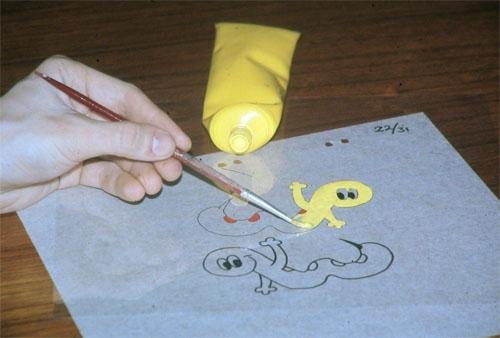
- The Ink-and-Paint Department: The completed paper drawings were passed to the ink-and-paint department—a division historically staffed almost exclusively by skilled women whose microscopic precision, steady hands, and aesthetic discipline formed the unsung backbone of the industry. Inkers hand-transferred the graphite outlines onto the front face of clear acetate cels using specialized dip pens and waterproof India ink. Once dry, painters (opaquers) turned the cel over to apply opaque vinyl gouache or acrylic paint to the reverse side, ensuring that brushstrokes remained completely invisible from the front.
- Multi-Layer Rostrum Camera Staging: The dried cels were delivered to the camera operator, who layered them over the original watercolor or gouache background on an adjustable rostrum table. A heavy optical glass platen pressed down with pneumatic pressure to squeeze out air bubbles and ensure perfect planarity before a single frame of 35mm film was exposed.
The Evolution from Nitrate to Acetate: The Chemical Battle
Early cels manufactured from cellulose nitrate were plagued by severe material vulnerabilities. Cellulose nitrate was chemically volatile, intensely flammable, and prone to spontaneous combustion under the intense heat of studio camera floodlights. Furthermore, as nitrate cels aged, they emitted hazardous nitric acid vapors, turning yellow, brittle, and shrinking unpredictably, which caused fragile paint layers to flake off in microscopic chips.
By the late 1930s and early 1940s, studios progressively transitioned to safety film: cellulose acetate and later cellulose triacetate. While acetate eliminated the terrifying fire hazards of nitrate, it introduced subtle physical challenges of its own, such as ‘vinegar syndrome’—a degenerative chemical autocatalysis where moisture triggers the breakdown of the acetate polymer, releasing acetic acid and causing the plastic sheet to warp, buckle, and crystallize. To combat these chemical instabilities, animation studios established climate-controlled ink-and-paint laboratories with strictly regulated humidity and dust-filtration systems.
| Production Stage | Primary Craft Artisans | Materials & Tools Employed | Critical Technical Objective |
|---|---|---|---|
| Layout & Posing | Layout Artists & Directors | Blue pencil, vellum paper, field guides | Establish staging, perspective grid, and camera framing |
| Key Animation | Senior / Lead Animators | Graphite pencil, lightbox, exposure dope sheets | Define performance, emotional acting, and physical weight |
| Inbetweening | Assistant Animators & Inbetweeners | Light tables, peg bars, timing breakdown charts | Execute fluid acceleration, deceleration, and arcs |
| Clean-Up | Clean-Up Department Artists | Specialized mechanical pencils, model sheets | Unify line weight and eliminate anatomical inconsistencies |
| Inking | Inkers (Ink & Paint Dept) | Cellulose cels, fine-nib crowquill pens, acetate ink | Transfer pristine line work onto the front of the transparent cel |
| Opaquing | Painters / Colorists | Hand-ground gouache paints, ox-hair brushes | Fill solid colors on the reverse face without streaking |
| Rostrum Photography | Camera Technicians | Vertical rostrum stand, pneumatic glass platen, 35mm camera | Expose multi-layered composite sandwich frame by frame |
The Assembly Line Methodology: Taylorism in the Creative Studio
John Randolph Bray’s restructuring of the animation studio was directly modeled upon Frederick Winslow Taylor’s ‘Principles of Scientific Management’. In a traditional art studio, an artist performed every function from conception to execution. Bray recognized that this holistic approach was economically unviable for producing weekly theatrical releases. He dissected the creative act into atomized, repetitive mechanical micro-tasks, assigning each worker a rigid, highly specialized responsibility.
Central to this industrial reorganization was the invention of the ‘Exposure Sheet’ (or ‘Dope Sheet’). The exposure sheet served as the master architectural blueprint and contractual ledger of the animated film. Divided into vertical columns representing audio cues, camera moves, and individual cel layers (Cel A, Cel B, Cel C, Cel D, Background), and horizontal rows representing individual movie frames (at 24 frames per second), the dope sheet enabled seamless communication across departments. A director or timing animator could precisely choreograph an intricate gag down to the exact 1/24th of a second, confident that the camera operator—working alone in a darkened camera room days later—would expose the exact cel combination specified on line 487 without needing verbal explanation.
This industrial assembly line also enabled the revolutionary technique of ‘cel cycling’ and ‘limited cel swapping’. If a character was talking while standing still, only their mouth or head needed to be redrawn on a separate upper cel layer (Cel B), while their entire torso, limbs, and clothing remained frozen on an underlying cel (Cel A) for dozens of frames. This technique slashed the number of complete drawings required for a six-minute cartoon from 8,000 to fewer than 2,000, drastically accelerating production velocity while maintaining visual richness.
The Bray-Hurd Monopoly Litigation and the Sherman Antitrust Act
The aggressive enforcement of the Bray-Hurd patents created immense legal turmoil throughout the American animation industry between 1915 and 1928. Bray and Hurd employed teams of corporate patent attorneys to audit competitor studios, serving cease-and-desist notices to any producer who dare photograph a drawing on a transparent sheet without paying licensing tribute. Small independent studios operating in New York and Chicago were frequently forced into bankruptcy or hostile mergers under the weight of patent infringement lawsuits.
However, as the 1920s progressed, rival animators—most notably Raoul Barré and the Fleischer brothers—began challenging the validity of the patents in federal court. Litigants argued that transparent celluloid had long been utilized in general photography, technical drafting, and theatrical stage lighting, claiming that Hurd’s application of cels to cartooning constituted an obvious mechanical extension rather than a patentable primary invention. Although the Bray-Hurd consortium successfully extracted hundreds of thousands of dollars in royalties during the silent era, the eventual expiration of the patents in 1932 liberated the industry, opening the floodgates for the independent artistic explosion that defined the Golden Age.
The Cel Sandwich and Multi-Level Optical Density Challenges
As artistic ambitions escalated during the Golden Age, directors began demanding increasingly elaborate compositions requiring four, five, or six overlapping cel levels beneath the rostrum camera. This introduced a critical optical dilemma: even the most transparent cellulose acetate was not perfectly optical glass; it absorbed approximately 8% to 10% of transmitted light and possessed a subtle greenish-amber tint.
Consequently, if a character was painted on the bottom cel layer (Level D) beneath three intervening blank cel sheets, their colors appeared significantly darker, muddier, and desaturated compared to a character painted on the uppermost cel layer (Level A). To resolve this perceptual color drift, studio ink-and-paint laboratories formulated complex, tiered color palettes. Paint technicians mixed specialized ‘Level D’ shades that were deliberately mixed several values lighter and more saturated than ‘Level A’ paints. When viewed through the stacked acetate sandwich, the compensated colors matched perfectly on the exposed 35mm film frame.
Furthermore, multiple acetate layers produced severe electrostatic attraction, drawing microscopic airborne dust particles and lint that created white flecks on the photographic negative. Studios responded by constructing positive-pressure clean rooms equipped with antistatic brushes, ionizing blowers, and velvet-gloved operators who wiped each cel with meticulous precision prior to platen clamping.
Xerography and the Death of Hand-Inking: Ub Iwerks’ 1960 Revolution
By the late 1950s, the exorbitant labor costs of hand-inking threatened to wipe out feature traditional animation entirely. The Walt Disney Studio had incurred massive financial deficits on ‘Sleeping Beauty’ (1959), whose hyper-detailed, Gothic-inspired hand-inked cels pushed production costs over $6 million. Disney’s brilliant optical engineer and legendary co-creator of Mickey Mouse, Ub Iwerks, turned to the burgeoning technology of xerography developed by the Haloid Xerox Corporation.
Iwerks modified a massive industrial Xerox camera with specialized quartz lenses and chemically sensitized selenium plates, enabling the electrostatic transfer of an animator’s original graphite pencil drawings directly onto transparent acetate cels. Debuting on ‘One Hundred and One Dalmatians’ (1961), xerography eliminated the entire hand-inking department, slashing production budgets by more than 50% and rescuing the studio from bankruptcy. More importantly, it preserved the raw, spontaneous, energetic pencil strokes of the master animators on screen for the first time in cinema history.
The Permanent Heritage of Cel Architecture in Modern Digital Suites
Although the last physical celluloid cels rolled off assembly lines in the early 2000s—superseded by digital ink-and-paint systems such as Toonz, Animo, and Toon Boom—the conceptual architecture forged by Earl Hurd and John Bray remains the universal lingua franca of modern computer graphics. Every contemporary digital creator who opens software operates within the structural ghost of the cel assembly line:
- Digital Layer Hierarchies: The non-destructive layer stack in Adobe Photoshop, Illustrator, and After Effects is the exact digital virtualization of Cel Levels A, B, C, and D resting above a background painting.
- Alpha Channels and Compositing Math: Digital matte transparency, Porter-Duff compositing operators, and masking logic are mathematical formulations of the physical opacity of paint on the reverse side of clear acetate.
- Timeline Keyframing and Dope Sheets: The digital dope sheets and graph editors in 3D Maya, Blender, and Cinema 4D directly mirror the paper exposure sheets typed by Bray and Disney directors ninety years ago.
The invention of cel animation was a profound triumph of human ingenuity over physical limitation. It demonstrated that by deconstructing artistic imagination into an organized, collaborative industrial discipline, human beings could systematically fabricate dreams out of plastic, paint, and light, gifting the world with an enduring pantheon of moving legends that will never fade from cultural memory.