The Hyperion Crucible: Transforming Cartoons into Fine Art
In the early 1930s, the animated cartoon in Hollywood occupied a humble, disposable niche in the theatrical hierarchy. Cartoons were viewed by theater owners and studio distributors merely as seven-minute musical comedic novelties—shallow ‘chasers’ intended to clear theater auditoriums between double-feature live-action melodramas. They were populated by rubbery barnyard animals executing repetitive dance steps to public-domain tin-pan alley tunes, characterized by crude physical gags and nonexistent dramatic stakes. One man, however, harbored an audacious, almost irrational conviction that the illustrated moving line possessed the aesthetic and emotional capacity to rival the grandest operas, classical literature, and Renaissance masterworks. That man was Walter Elias Disney.
Operating from his bustling studio lot on Hyperion Avenue in the Silver Lake district of Los Angeles, Walt Disney initiated an unprecedented cultural and technological renaissance. Rather than being satisfied with the enormous commercial success of Mickey Mouse and the Silly Symphony series, Disney reinvested every solitary cent of studio profit into artistic research, physiological experimentation, chemical formulation, and optical engineering. Between 1932 and 1942—a period universally recognized as the Golden Age of Disney Animation—the Hyperion Studio transformed animation from a raucous novelty into a sovereign fine art of staggering visual majesty and profound emotional pathos.
This transformation was neither accidental nor purely intuitive; it was the product of a systematic, institutionalized commitment to aesthetic mastery. Walt Disney established mandatory formal life-drawing academies within the studio, engaged renowned Chouinard Art Institute professors to teach anatomical biomechanics, constructed specialized chemical laboratories to synthesize proprietary gouache colors, and oversaw the design of revolutionary optical machinery—most notably the monumental Multiplane Camera. This feverish decade of relentless innovation culminated on December 21, 1937, with the world premiere of ‘Snow White and the Seven Dwarfs’, a transcendent triumph that stunned a skeptical Hollywood establishment and altered the trajectory of cinema history forever.
👑 Industry Milestone: Disney’s Gamble — ‘Disney’s Folly’ (1934–1937)
When Walt Disney announced in 1934 that his studio would produce a full-length, 83-minute feature animated film in full Technicolor based on the Brothers Grimm fairy tale ‘Snow White’, Hollywood insiders, trade journalists, and even Disney’s own brother and financial manager Roy O. Disney ridiculed the project as ‘Disney’s Folly’. Skeptics declared that adults would never sit through an 80-minute cartoon, that audiences would suffer collective ocular migraine headaches from the bright saturated colors, and that the studio would go bankrupt. Instead, ‘Snow White’ grossed $8 million during its initial theatrical run, becoming the highest-grossing sound film of all time up to that date.
The Multiplane Camera: Conquering the Third Dimension
Prior to 1937, the most glaring aesthetic limitation of the animated medium was its absolute, planar flatness. When a live-action cinematographer pushed a physical camera toward an outdoor set, an intricate optical phenomenon known as ‘motion parallax’ occurred: foreground objects (such as tree branches or street lamps) rushed past the lens with rapid visual displacement, midground structures (such as cottages or wagons) drifted past with moderate speed, and distant background features (such as mountain ranges and the moon) remained virtually stationary on the horizon. This relative velocity differential provided the human brain with vital depth perception cues.
In traditional flat cel animation, however, all visual elements—foreground, character, and background—were compressed into a single composite sheet resting beneath a flat camera platen. Consequently, when a camera zoomed in toward an animated house, the house, the fence, the flowers in the front yard, and the distant mountains all expanded at the exact same uniform rate. The visual result was psychologically jarring and artificial: instead of the camera penetrating through three-dimensional space, the illustration simply appeared to grow larger, destroying any cinematic suspension of disbelief.
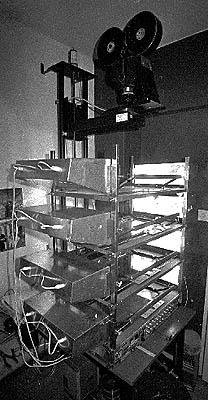
To eliminate this planar defect, Disney director and optical engineer William E. Garity designed and constructed the legendary Multiplane Camera in 1937. Standing over eleven feet tall, the multiplane apparatus was a colossal, vertical steel gantry resembling a massive industrial printing press. Rather than resting on a single tabletop, the artwork was distributed across up to seven independent horizontal sheets of optical glass, separated by vertical air intervals of several feet. A motorized 35mm Technicolor camera was suspended at the apex of the structure, pointing downward through the glass strata.
The Mechanical and Lighting Architecture of the Multiplane Gantry
The operational mechanics of the Multiplane Camera required astonishing precision and team choreography. Each glass level was mounted within an independent steel carriage equipped with micrometer wheels and worm gears, allowing camera operators to shift individual glass planes in any direction—north, south, east, west, or vertically along the z-axis—at micro-millimeter increments:
- Independent Plane Illumination: Because multiple layers of glass would naturally attenuate light and cast unwanted shadows upon underlying tiers, each glass tier was fitted with its own independent, color-calibrated bank of diffused incandescent floodlights. This allowed lighting technicians to simulate delicate atmospheric effects, such as soft moonlight filtering through upper forest canopies while keeping the lower forest floor in deep, moody chiaroscuro.
- Differential Focal Depth: By physically separating the glass layers by several feet, the multiplane camera allowed the camera lens to achieve genuine optical depth of field. Foreground leaves could be rendered intentionally soft and out of focus, drawing the audience’s emotional focus toward the sharply defined character in the midground, while distant castle spires receded into painterly atmospheric haze.
- The Test Flight: The Old Mill (1937): Disney tested the multiplane camera on the Silly Symphony short ‘The Old Mill’ (1937). The opening tracking shot—gliding past delicate spiderwebs trembling with morning dew, through decaying wooden mill gears, and deep into the nesting grounds of owls and swallows—was so visually revolutionary that it earned the studio the Academy Award for Best Animated Short Subject and a special Scientific and Technical Academy Award.
| Multiplane Tier | Visual Content / Layer | Lighting Configuration | Optical / Parallax Behavior |
|---|---|---|---|
| Level 1 (Top / Nearest) | Overhanging tree boughs, cobwebs, hanging vines | Soft edge-lighting, low illumination intensity | Rapid lateral translation, shallow depth-of-field soft focus |
| Level 2 (Upper Mid) | Forest trees, stone fences, architectural gateposts | Directional key lighting calibrated to scene mood | Moderate lateral tracking speed, sharp focal definition |
| Level 3 (Action Mid) | Character animation cels (Snow White, Animals) | Balanced high-intensity fill lights, anti-glare filters | Primary focal plane; characters interact with environment |
| Level 4 (Lower Mid) | Cottage exterior, floral gardens, flowing streams | Atmospheric backlighting, ambient watercolor wash | Gentle parallax drift, reinforcing structural scale |
| Level 5 (Deep Horizon) | Distant alpine mountains, moon, twilight sky | Uniform cool diffusion lamps behind tracing paper | Virtually zero lateral displacement; creates infinite depth |
The Chouinard Art Classes: Don Graham and the Science of Life Drawing
While the Multiplane Camera conquered physical space, Walt Disney recognized that his animators were artistically ill-equipped to draw realistic human anatomy, subtle facial emotion, and the heavy drapery of fairy tale heroines. The rubber-hose elasticity of early Mickey Mouse and silly symphonies was totally inadequate for serious dramatic storytelling. In 1932, Disney hired Don Graham, a visionary master instructor from the Chouinard Art Institute, to establish an internal studio art academy.
Every evening after regular studio hours, the Hyperion drafting rooms were transformed into high-intensity master life-drawing classes. Graham brought in professional athletes, Olympic gymnasts, classical ballet dancers, and even live animals—including two young fawns that lived in a pen behind the studio during the pre-production of ‘Bambi’—for the artists to study. Animators were compelled to abandon cartoon formulas and analyze the fundamental structural physics of living bodies: the mechanics of skeletal articulation, the contraction and extension of muscle groups, the shifting center of gravity during locomotion, and how fabric wrinkles and folds over moving flesh.
Out of Don Graham’s rigorous Hyperion lectures emerged the foundational codification of the ‘Twelve Basic Principles of Animation’. Master animators such as Art Babbitt, Fred Moore, Bill Tytla, and Grim Natwick systematically decomposed movement into reproducible principles: Squash and Stretch, Anticipation, Staging, Straight Ahead Action and Pose to Pose, Follow Through and Overlapping Action, Slow In and Slow Out, Arcs, Secondary Action, Timing, Exaggeration, Solid Drawing, and Appeal. These principles provided the scientific grammar that allowed Disney artists to imbue hand-drawn ink lines with genuine biological soul.
🔥 Character Acting Milestone: Bill Tytla and the Creation of Grumpy and Chernabog
Ukrainian-American master animator Vladimir ‘Bill’ Tytla revolutionized character acting in animation through his raw, muscular, psychological approach. When animating Grumpy in ‘Snow White’, Tytla did not treat the dwarf as a comic gag; he channeled deep human vulnerability, showing Grumpy’s abrasive exterior gradually crumbling under Snow White’s genuine warmth. Later, in ‘Fantasia’ (1940), Tytla animated the demonic winged deity Chernabog atop Bald Mountain, producing a terrifying, sculptural masterwork of raw anatomical power that remains one of the greatest feats of draftsmanship in world cinema.
The Climax of the Golden Age: Pinocchio and Fantasia (1940)
Flushed with the unprecedented global profits of ‘Snow White’, Walt Disney embarked upon the most creatively ambitious, technically complex, and financially extravagant artistic streak in Hollywood history. Released in February 1940, ‘Pinocchio’ stands as the undisputed technical peak of traditional hand-drawn cel animation. Every solitary frame of ‘Pinocchio’ was an intoxicating display of craft perfection: intricate hand-carved Bavarian clocks with dozens of microscopic moving gears, atmospheric underwater sequences utilizing multiplane glass distortion with floating bubbles and rippling kelp, and the monstrous sperm whale Monstro, whose ocean breaches were rendered with thousands of meticulously hand-drawn foam splashes and churning seafoam layers.
Nine months later, in November 1940, Disney released ‘Fantasia’—a monumental avant-garde fusion of classical symphonic music conducted by Leopold Stokowski and the Philadelphia Orchestra with abstract, mythological, and cosmic visual interpretation. To present ‘Fantasia’, Disney invested hundreds of thousands of dollars to invent ‘Fantasound’—the world’s first commercial multi-channel stereophonic theater sound system, utilizing thirty-eight separate optical audio channels and surround-sound auditorium speakers decades before Dolby or DTS existed.
The Disney Color Model Lab: The Chemistry of Emotional Pigment
A critical, often overlooked pillar of the Hyperion studio’s supremacy was its proprietary paint laboratory. Dissatisfied with standard commercial gouaches, Disney hired professional chemists to synthesize exclusive pigments under the leadership of color stylist Hazel Sewell. The studio formulated over 1,500 distinct, custom-blended paint shades, each assigned a precise alphanumeric index in a guarded studio swatch book.
This scientific control over color temperature, hue, and saturation allowed Disney directors to utilize color psychologically. In ‘Snow White’, the Evil Queen’s domain is dominated by cold, poisonous chromatic schemes of viridian green, bruised violet, and obsidian black. In contrast, the dwarfs’ forest cottage glows with warm, reassuring earthen hues: raw sienna, burnt umber, honey gold, and soft cadmium red. Every tint was mathematically formulated to interact harmoniously with the three-strip Technicolor emulsion, ensuring that the characters radiated emotional truth under cinematic projection.
The Multiplane Legacy in Modern Visual Effects
The engineering principles developed for the Multiplane Camera by William Garity directly birthed the visual architecture of modern optical and digital compositing. Before the multiplane gantry, filmmakers could not combine practical live-action plates with painted visual environments without visible fringing, grain mismatch, and static perspective cues.
In later years, the multiplane principle was miniaturized and adapted for aerospace simulation, military reconnaissance mapping, and special effects facilities such as Industrial Light & Magic. When computer graphics emerged in the 1980s, the multiplane gantry served as the foundational conceptual model for digital 2.5D compositing systems, where flat 2D bitmap illustrations are arranged along a virtual z-axis camera coordinate system within software like Adobe After Effects and Nuke. The physical steel towers of the Hyperion studio may have been dismantled, but their mathematical and optical geometry continues to dictate how cinematic illusions of depth and atmospheric scale are constructed across global screens.
| Disney Feature Masterpiece | Release Year | Key Technical / Artistic Milestone | Directorial / Engineering Leadership |
|---|---|---|---|
| Snow White and the Seven Dwarfs | 1937 | First full-length cel animated feature in Technicolor | David Hand, William Cottrell, Wilfred Jackson |
| Pinocchio | 1940 | Apotheosis of mechanical drafting, water physics, Monstro | Ben Sharpsteen, Hamilton Luske, Bill Tytla |
| Fantasia | 1940 | Fantasound stereophonic audio, abstract visual symphony | Samuel Armstrong, James Algar, Leopold Stokowski |
| Bambi | 1942 | Tyrus Wong impressionist backgrounds, anatomical realism | David Hand, Perce Pearce, Marc Davis |
| Cinderella | 1950 | Post-war studio rebirth, Mary Blair color styling | Clyde Geronimi, Hamilton Luske, Wilfred Jackson |
The Enduring Heritage of the Hyperion Studio
The Golden Age of Disney was brought to an abrupt, tragic halt by a devastating convergence of historical catastrophes. In May 1941, deep-seated grievances over profit sharing, screen credit, and studio paternalism erupted into the bitter Disney Animators’ Strike, shattering the fraternal, egalitarian community of the Hyperion days. Six months later, the Japanese attack on Pearl Harbor plunged the United States into World War II; the United States military requisitioned the studio lot to house anti-aircraft battalions, and the lucrative European box office was completely obliterated, plunging Disney into severe financial distress.
Yet the artistic and technical achievements forged during that decade at Hyperion remain the gold standard against which all cinematic animation is judged. Disney proved that animation was not a lower-tier amusement for children, but a limitless cinematic art form capable of universal tragedy, divine awe, poetic romance, and psychological transcendence. The visual grammar, optical machinery, and anatomical principles created during the Golden Age established an eternal artistic canon that continues to guide, inspire, and elevate animators in every corner of the modern world.