The Holy Trinity of Kinetic Illusion: The Soul of Motion
Across all disciplines of moving visual art—from classical hand-drawn cel animation and physical stop-motion puppetry to high-end 3D character animation and modern digital motion graphics—there exists a profound, universal truth that separates amateurish, floaty, unconvincing animation from breathtaking, visceral, living movement. That truth does not reside in the resolution of the screen, the complexity of the rendering engine, or the polygon count of the character mesh. It resides entirely within the mastery of three fundamental, deeply interconnected kinetic concepts: Timing, Spacing, and Weight.
These three concepts form the holy trinity of animation mechanics. They are the invisible psychological and physical threads that bind moving graphics to the human visual cortex. An artist can draw the most exquisite, museum-grade illustrative character, but if the timing is sluggish, the spacing is linear, and the weight is unresolved, the character will instantly feel like a dead, wooden doll drifting through empty space. Conversely, a brilliant animator can take a simple geometric white circle on a black screen, and through flawless manipulation of timing and spacing, endow that circle with tangible physical mass, gravitational vulnerability, biological breathing, and a tragic, heartbreaking emotional personality.
To understand the mechanics of believable movement is to enter the shared realm of classical Newtonian physics, neurobiology, and theatrical acting. It requires an animator to deconstruct time into micro-intervals of twenty-fourths of a second, analyzing how inertia resists motion, how momentum propels mass forward, and how the human brain instinctively calculates the density and emotional state of an object purely by observing how it travels across space.
⏱️ Master Dictum: Grim Natwick on the Essence of Timing
Legendary master animator Grim Natwick—who animated Betty Boop and served as the lead animator on Snow White at Disney—famously declared: ‘Animation is not the art of drawings that move, but the art of movements that are drawn. What happens between each frame is vastly more important than what exists within any solitary frame.’
Deconstructing Timing: The Speed and Rhythm of Narrative Beats
In the technical lexicon of animation, ‘Timing’ refers strictly to the total duration of an action: how many frames of film or video are allocated for a movement from its initial pose to its final destination. Operating within the standard cinematic temporal baseline of 24 frames per second (fps), timing establishes the baseline velocity of physical existence:
- Mass and Inertia Determination: Timing is the primary sensory cue that communicates the physical mass of an object to the human brain. If a bowling ball and an inflated balloon are dropped from the same height, they travel with identical theoretical gravitational acceleration in a vacuum; but in the real physical atmosphere, the bowling ball crashes into the floor in 6 frames, while the light, buoyant balloon floats, oscillates, and drifts across 48 frames. The viewer perceives the mass of the bowling ball not because it is painted black, but because of its brutal, rapid timing.
- Emotional and Psychological Subtext: Timing defines character temperament, emotional status, and dramatic subtext. A character who checks their wristwatch in 4 frames is in an explosive, terrified panic; a character who checks their watch in 12 frames is mildly impatient; and a character who checks their watch in 36 frames is profoundly bored, exhausted, or melancholy. By adjusting frame counts by merely two or three frames, an animator completely rewrites the psychological narrative.
- The Power of the Freeze-Frame Hold: In comedic and dramatic timing, the absence of movement is as potent as movement itself. Pioneered by Chuck Jones at Warner Bros., the ‘hold’—freezing a character in an extreme pose for 8 to 16 frames while their eyes dart—allows the audience’s brain to absorb the dramatic gravity of a situation before unleashing the explosive physical reaction.
Deconstructing Spacing: The Secret Engine of Acceleration
While timing defines the total time taken for an action, ‘Spacing’ is the critical, often misunderstood artistic variable that defines how that action unfolds across space. Spacing refers to the physical distance between each successive drawing or frame position within that allotted time:
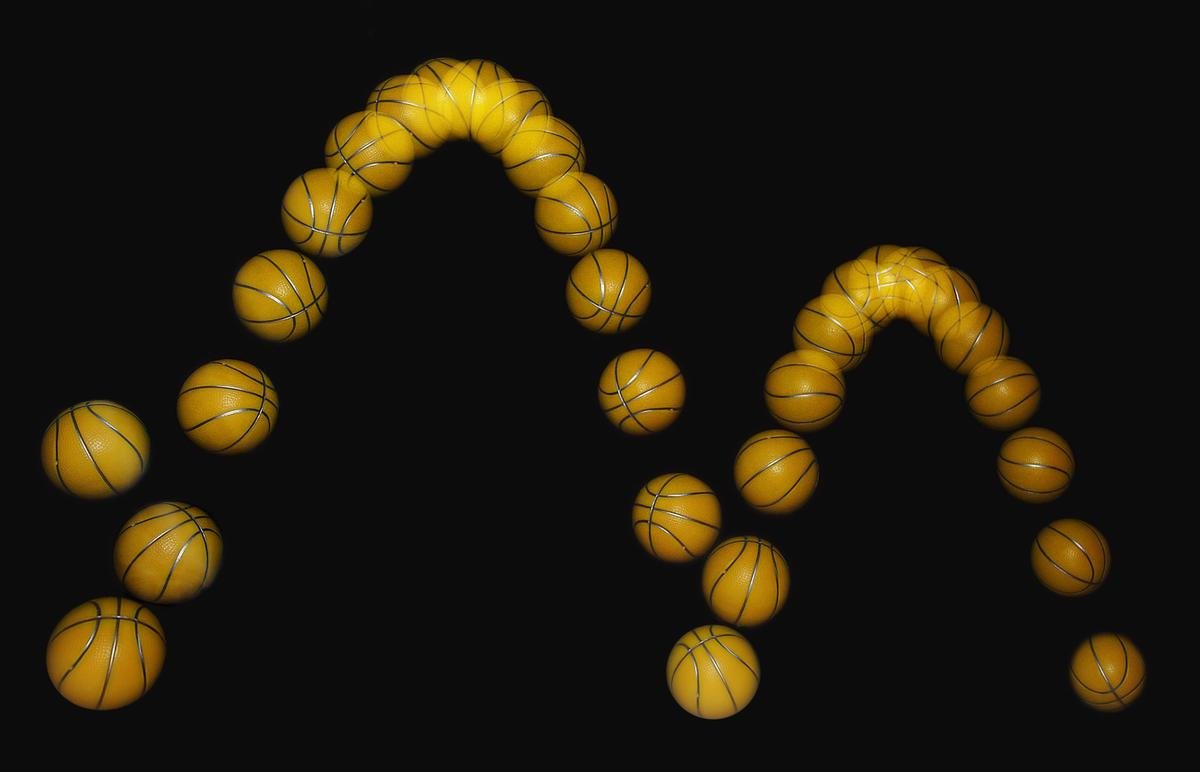
If an object moves from Point A to Point B across twelve frames, how is the physical distance divided? If the distance is divided into twelve equal, uniform spatial increments, the object moves with rigid, robotic linear velocity—a mechanical flaw common in amateur motion graphics. In the organic physical world, virtually nothing moves with uniform linear velocity; objects must overcome inertia, accelerate, cruise at peak velocity, and decelerate against friction. By clustering drawings close together at the beginning (Slow Out) and clustering them close together at the end (Slow In), with wide, expansive intervals in the middle, the animator creates the sensation of organic acceleration, muscular effort, and natural physical settling.
| Motion Design Concept | Physical Governing Law | Visual Manifestation on Timeline | Auditory / Emotional Psychological Response |
|---|---|---|---|
| Tight Spacing (Clustered) | Static Friction / Inertial Resistance | Frames tightly overlapping with micro-displacements | Anticipation, building tension, sluggish heavy mass |
| Wide Spacing (Expansive) | Kinetic Energy Apex / Maximum Velocity | Frames separated by large spatial gaps (often smeared) | Explosive speed, whiplash impact, supersonic velocity |
| Slow In (Cushioning) | Kinetic Energy Dissipation / Deceleration | Progressively diminishing spatial gaps toward end pose | Graceful arrival, soft landing, controlled settling |
| Slow Out (Launch) | Work Overcoming Inertia / Acceleration | Progressively expanding spatial gaps from start pose | Muscular propulsion, explosive launch, coiled release |
| Smear Frame / Speed Line | Retinal Motion Blur Simulation | Elongated, painterly graphical stretch across frame | Perceived continuous velocity defying frame-rate stutter |
The Physics of Weight: Simulating Gravity, Friction, and Momentum
Simulating believable physical ‘Weight’ is the ultimate crucible of the animator’s craft. Weight is not an inherent graphic attribute that can be drawn directly; an artist cannot simply draw a ‘heavy line’. Weight is an emergent perceptual illusion synthesized entirely through the dynamic interaction of Timing, Spacing, and Secondary Reaction:
- Center of Gravity and Balance: A heavy living organism must constantly adjust its center of gravity over its physical base of support. When an elephant or a heavyweight boxer takes a step forward, their entire torso shifts laterally over the supporting foot before the trailing foot can leave the ground. If an animator moves the trailing foot forward before the mass has shifted, the character instantly looks weightless, like a styrofoam balloon sliding across ice.
- The Ground Impact Rebound: When a heavy physical mass strikes the earth, the energy must go somewhere. A heavy character does not merely stop; their knees bend deep into a dynamic squash, their belly and cheeks drag downward under momentum and slap against their bones, and the impact shockwave reverberates through their spine before they settle back into a stable standing posture.
- The Principle of Recoil and Drag: When an animated creature changes direction, the heavy portions of the body lead the movement, while the flexible, trailing masses drag behind in a delayed arc of inertia. When a giant prehistoric creature swings its massive tail, the muscular base of the tail near the hips moves first, while the tip of the tail remains stationary for several frames before snapping through space with whip-like acoustic ferocity.
📈 Modern Digital Graph Editors: Translating Spacing into Bézier Math
In modern 3D animation suites (Maya, Blender, Cinema 4D, After Effects), the traditional animator’s paper exposure sheet and timing chart have been transformed into the ‘Graph Editor’. The vertical axis represents spatial value, while the horizontal axis represents time in frames. The slopes and curvature of the Bézier curve tangents are the literal mathematical translation of Spacing: a steep vertical slope represents wide spacing and supersonic velocity, while a flat horizontal plateau represents tight spacing, cushioning, and stationary holds.
Rhythm, Cadence, and Musicality in Motion Design
Beyond the strict laws of Newtonian mechanics, master animators recognize that movement is fundamentally an acoustic and musical phenomenon. Great animation possesses rhythm, cadence, syncopation, and musical polyphony. If every action in a film unfolds with identical timing and spacing, the film becomes a monotonous, numbing drone that lulls the audience into psychological disengagement.
Master animators structure their scenes like jazz compositions, interweaving fast, staccato physical accents with slow, languid, atmospheric pauses. A character might sprint frantically across a room in four blistering frames, skid violently to an abrupt dead stop, freeze in a deadpan hold for sixteen frames while their chest pants with heavy breathing, and then slowly tilt their head in a delicate twenty-frame realization. This dynamic contrast between explosive acceleration and quiet contemplation keeps the audience’s visual cortex continuously stimulated, engaged, and emotionally aligned with the story.
Motion Paths and Spatial Trajectory: Visualizing Velocity Arcs
In modern digital software suites such as Adobe After Effects, Cinema 4D, and Autodesk Maya, an animator’s command of spacing is directly visualized through ‘Motion Paths’. A motion path displays the continuous spatial trajectory of an animated object across the screen as a colored vector spline, punctuated by discrete anchor points representing each individual frame.
By inspecting the spacing between these frame dots, an animator can instantly audit the physical credibility of an action without even pressing play. If the frame dots are evenly spaced along a straight line, the object will move with stiff, robotic velocity. If the dots curve gracefully along sweeping parabolic arcs—clustering closely together at the apex of a jump to simulate gravitational deceleration, and spreading widely apart during the downward plunge—the motion path proves that the object obeys physical momentum. Master animators manipulate the Bézier tangent handles directly on the spatial motion path, fine-tuning the centrifugal force and aerodynamic drag of a flying superhero or swinging pendulum down to the pixel.
The Digital Interface Frontier: Timing and Spacing in UI/UX Design
In the contemporary digital landscape, the mastery of timing, spacing, and weight has transcended cinematic storytelling to become the foundational grammar of modern user interface (UI) and user experience (UX) design. When a user swipes a smartphone screen, taps an interactive button, or dismisses a modal notification, the software executes dynamic micro-interactions designed to reassure human psychology.
If an app menu appears instantaneously with zero frames, the transition feels jarring and harsh; if it slides in over 600 milliseconds, it feels sluggish and frustrating. UX motion designers utilize standard timing windows between 200ms and 350ms, calibrated with asymmetric cubic-bézier easing curves (e.g., cubic-bezier(0.25, 0.1, 0.25, 1.0)). By applying Disney’s principles of slow-in, spring anticipation, and gentle settling recoil to digital buttons and cards, product designers create intuitive interfaces that feel physically responsive, tactile, and natural to the human touch.
| Motion Domain | Typical Timing Window | Primary Spacing Curve | Governing Design Objective |
|---|---|---|---|
| Feature Character Acting (3D) | 12 to 48 frames (500ms to 2000ms) | Complex multi-tangent S-curves with anticipatory dips | Communicate biological weight, emotional psychology, acting truth |
| Slapstick Cartoon Action (2D) | 2 to 8 frames (80ms to 330ms) | Extreme snap curves; 1-frame smear holds with abrupt stops | Maximize comedic impact, kinetic surprise, violent shockwaves |
| UI Mobile Micro-Interactions | 150ms to 300ms (4 to 7 frames at 60Hz) | Asymmetric ease-out; fast entrance with smooth cushioning | Instantaneous user responsiveness without jarring optical flicker |
| Motion Graphics Logo Reveals | 60 to 120 frames (2.5s to 5.0s) | Rhythmic polyphonic staggered offsets with spring settling | Establish brand elegance, visual hierarchy, polished luxury |
The Stopwatch and the Mirror: The Empirical Laboratory of Timing
Throughout the golden age of hand-drawn animation, the single most indispensable physical instrument hanging around an animator’s neck was not a specialized pencil or an eraser; it was a high-precision mechanical stopwatch calibrated in twenty-fourths of a second. Animators did not guess how long an action took; they physically enacted the performance themselves in front of full-length studio mirrors, clicking the stopwatch at the exact moment of anticipation, apex, and settling.
Master animators like Bill Tytla and Chuck Jones would spend hours acting out a scene: standing up, pacing across the room, slamming a door, or rubbing their chin while counting frames under their breath. By measuring their own biological cadence, animators calibrated the physical truth of human locomotion before touching graphite to paper. Even in today’s modern 3D and VFX studios, animators routinely record video reference of themselves acting out emotional beats on their smartphones, frame-stepping through the playback to study the micro-spacing of real human hesitations, ensuring that digital animation remains grounded in authentic physical truth.
As the visual storytelling industries continue their relentless technological march into generative artificial intelligence, algorithmic asset synthesis, and automated procedural physics simulations, the foundational mastery of Timing, Spacing, and Weight remains the irreplaceable sovereign domain of the human artist. Automated algorithms can calculate mathematical collisions and cloth friction, but an algorithm can never understand the comedic poetry of an intentional micro-delay, the poignant tragedy of a hesitant settling breath, or the joyful exuberance of a bouncy musical walk cycle.
Timing, spacing, and weight are not mechanical checkboxes; they are the language of human empathy itself. By mastering these invisible laws of kinetic life, animators transform pixels, paint, and clay into vibrant vessels of truth and emotion, continuing the eternal human tradition of breathing life into the blank void and proving that our most profound stories are those spoken through the universal, living language of motion.